Every framework for picking a startup idea starts in the wrong place. Market size. TAM. What the biggest company in the space is making today. Run the numbers, see if it’s big enough, then decide. It sounds rigorous. It’s actually backwards.
The spreadsheet founder
A market-sizing slide is proof you’re already too late.
The standard move is a case study: what’s the market size today, what’s the biggest player making, extrapolate from there. It feels like diligence — like the responsible way to decide whether something is worth three to ten years of your life.
But the method can only measure markets that already exist, priced by companies that already proved they exist. By the time an idea shows up cleanly on a market-sizing slide, someone already answered the question for you — usually with a two-year head start you don’t have.
Conviction has to come first
No spreadsheet would have funded SpaceX.
In 2002, there was no reusable-rocket market to size, because the number was zero. NASA had spent a decade treating cheap access to space as a solved, boring problem not worth touching. Run the market analysis on “build orbital rockets from scratch as a private company” and the answer is pass. Obviously pass.
What a spreadsheet can’t capture is Elon Musk (SpaceX’s founder and CEO) putting a hundred million dollars of his PayPal money into three consecutive rocket failures, watching the company nearly go bankrupt, and doing it again anyway — because he believed humanity needed to become a multi-planet species before it was optional. That’s not a market bet. That’s a conviction that came first and dragged a market into existing after it.
Market sizing tells you what’s already been proven. Conviction is what proves something new.
Money isn’t the only scoreboard
Profitable is not the same as good.
That’s the second premise, easy to miss because it looks like the same point as the first. How you decide to start is one question. What you’re optimizing for once you’ve started is a different one entirely.
Yvon Chouinard (Patagonia’s founder) spent decades running the least ambitious apparel company in America, on purpose. Patagonia capped growth while competitors chased it. Gave away 1% of sales to environmental causes before it was a marketing line other companies could copy. And in 2022, once the company was worth around three billion dollars, he gave the whole thing away — ownership and all — structured so every dollar of profit not reinvested in the business goes to fighting climate change. “Earth is now our only shareholder”, he wrote.
None of that optimizes for revenue. It was never supposed to. The company was pointed at something else the entire time, and being profitable was the mechanism, not the goal.
Two separate failure modes, not one. You can talk yourself out of a good idea by demanding it look good on a spreadsheet first. Or you can build something that works financially and still be building the wrong thing — because the only scoreboard you were optimizing for was the dollar amount.
The OnlyFans test
If revenue were the only scoreboard, OnlyFans would be one of the best businesses ever built.
Fiscal 2023: $1.3 billion in revenue, $658 million in pre-tax profit, 42 employees. That’s roughly $31 million in revenue per employee — by some estimates it hit $37.6 million in 2024. Compare that to Amazon, at something like $400,000 per employee, and it’s not close.
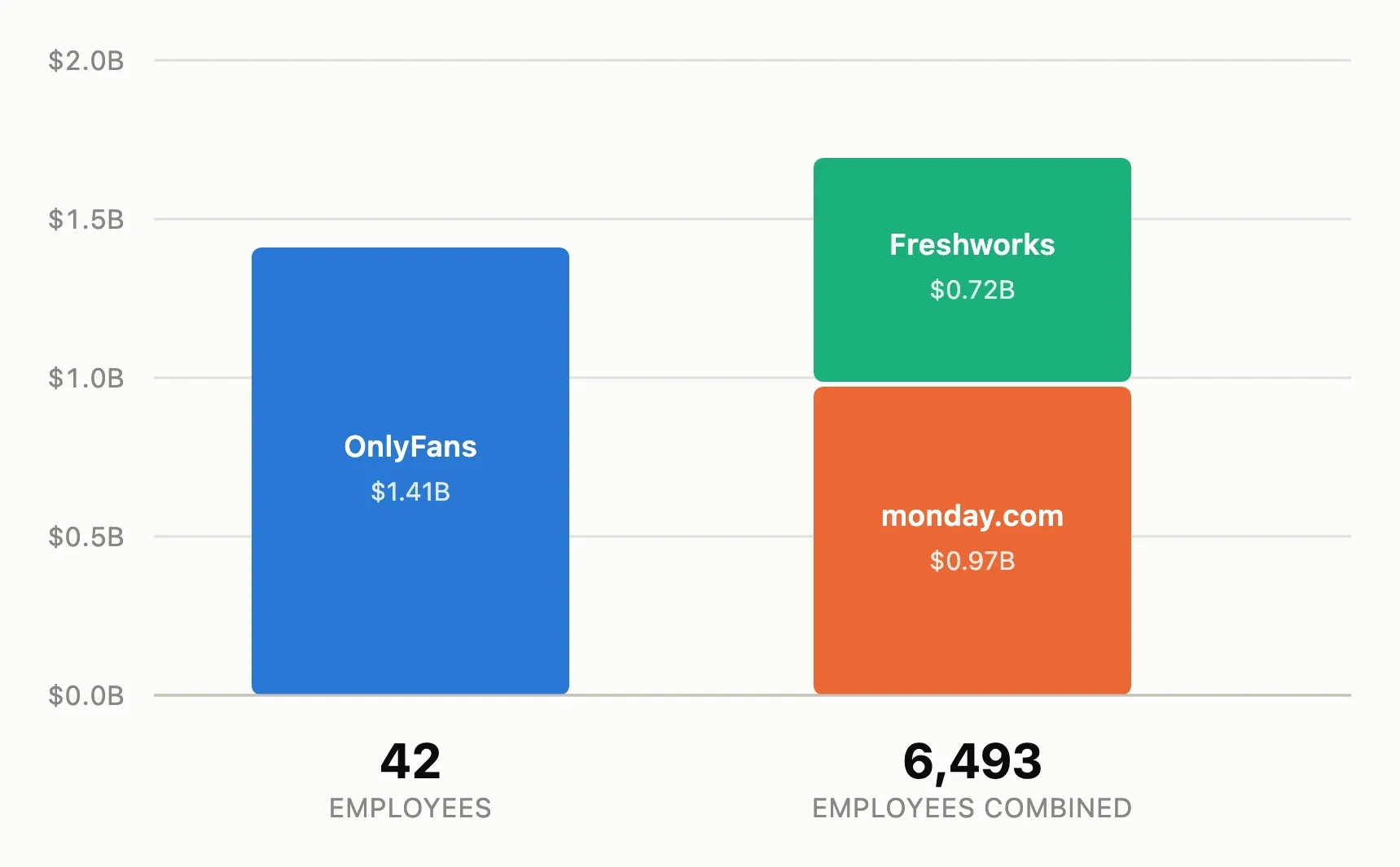
That match in dollars doesn’t mean the two sides created the same amount of value in the world. It means they captured a similar amount — with wildly different numbers of people doing the capturing.
Gambling apps prove the same point even though most of them lose money on paper. DraftKings burns cash acquiring customers — but that’s beside the point. The point is who’s actually generating the revenue once someone’s acquired. A 2023 study by NatCen Social Research (commissioned by the UK’s Gambling Commission) found the top 10% of online gamblers generate 80% of industry revenue. The top 1% generate 36% of it, alone. That’s not a company monetizing a product. That’s a company monetizing a small number of people who can’t stop.
Stack either of those next to every CRM company, every B2B SaaS startup counting a 10% net margin as a win, and by pure revenue-per-employee logic, the SaaS companies are a rounding error.
Revenue-per-employee doesn’t distinguish between value created and value extracted, and a scoreboard that can’t tell the difference is broken. High margin isn’t proof something good happened. Sometimes it’s proof the other person had no way to say no.
Now run the test in the other direction. Teaching is about as close to pure value creation as anything humans do, and it’s near the bottom of any revenue-per-employee ranking you’ll find. That’s exactly backwards. The metric doesn’t just overrate compulsion — it underrates the highest-value work there is, because that work was never built to extract anything back.
Creating it and capturing it are different games
Same revenue can mean two completely different things happened to produce it.
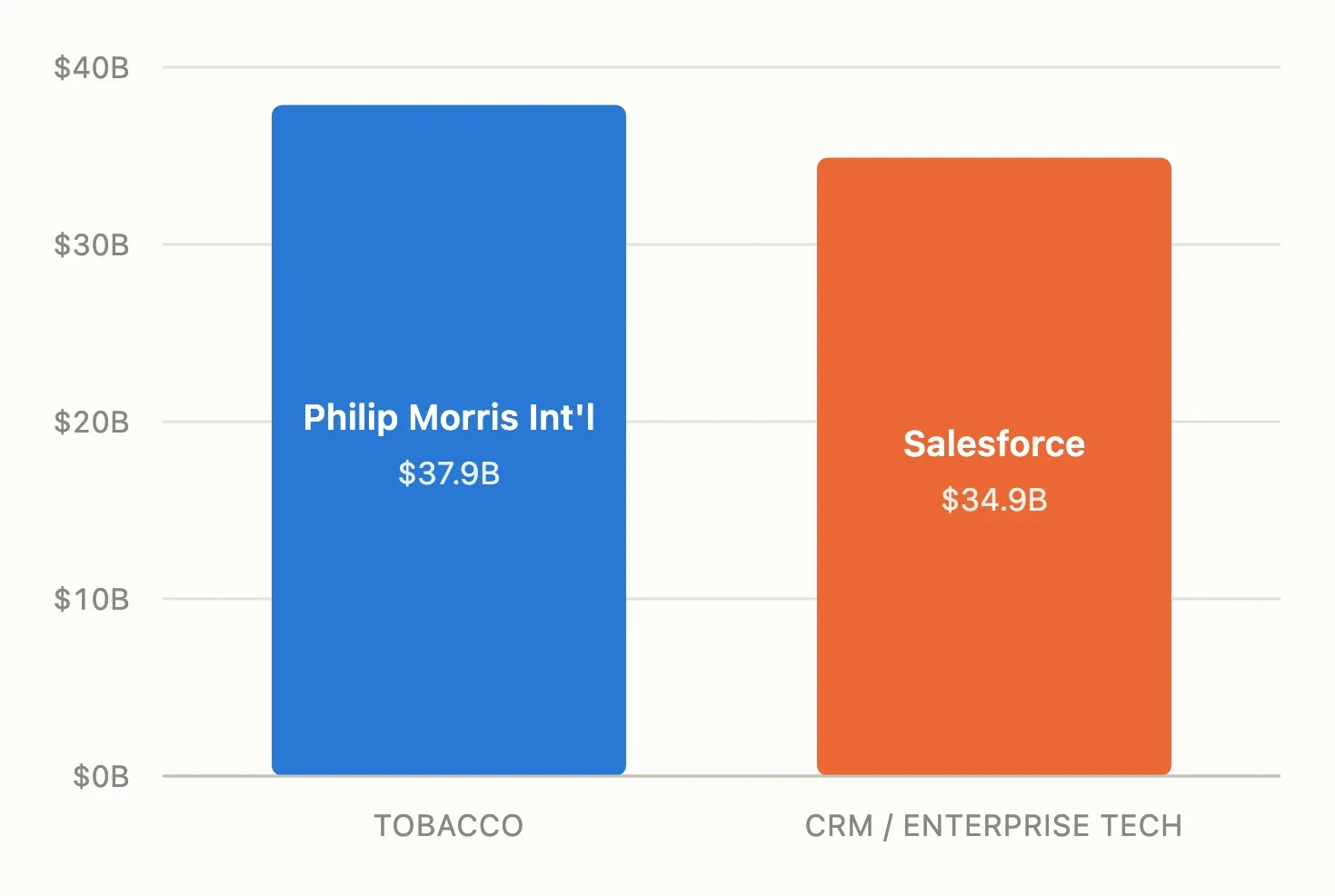
Salesforce and Philip Morris International post almost identical numbers — $34.9 billion against $37.9 billion a year. Look at what sits on either side of that revenue, though. Every company running Salesforce is using it to close deals and generate revenue of its own that dwarfs what it pays for the software. Salesforce captures a sliver of a pie it helped grow. Philip Morris International’s product doesn’t grow anyone else’s pie. There’s no downstream business getting richer because more people smoke. PMI is capturing a much bigger share of a pie that’s smaller to begin with — negative, once you count what smoking costs the people paying for it.
Same revenue. Almost opposite ratio of value created to value captured. That ratio is the thing worth optimizing for. The revenue number sitting on top of it is not.
Pick what you’re optimizing for
None of this — the empires, the fundraising rounds — means what it feels like it means, from far enough away.
That’s the one idea from astronomer Carl Sagan’s Pale Blue Dot that’s stuck with me longer than the rest of the book. The size of the stage doesn’t tell you what deserves to be performed on it.
Meaning isn’t handed to you. It’s what you decide to spend the thing on.
Some people build their life around pleasure. That’s a real answer. No argument there.
But look back at Musk and Chouinard. One bet his fortune on humanity surviving as more than a single-planet species. The other gave his company away to keep the planet livable enough to bother building anything on. Neither one was optimizing for a dollar amount, and neither one was optimizing for being a good person, either. Both were optimizing for whether we get to keep going.
That’s the actual test, and it’s rougher than any word like virtue makes it sound: does this move the species forward, or does it just move money around? Does it make us a little more likely to still be here in a hundred years — or does it just make someone richer while we find out?
Aim at creating value and, done disruptively enough, you usually capture more of it too — that’s what disruption actually is: creating enough new value that the old system can’t stop you from keeping your share. But the argument has a ceiling, and it isn’t economic, it’s biological. People are wired at a pretty primitive level — wanting sex, wanting to get high, wanting the next hit of anything that feels good — and that wiring guarantees demand no matter how little value sits behind it. Some money was never on the table because someone built something better. It was on the table because it was standing in front of an itch people can’t not scratch.
Don’t start with the spreadsheet. It can only tell you what already worked for somebody else. Start with what you actually believe is worth building, and let that decide who it’s for — and what you’ll say no to along the way. If the honest answer to “why this” is a market-size slide, you haven’t found the reason yet.
September 14, 2026